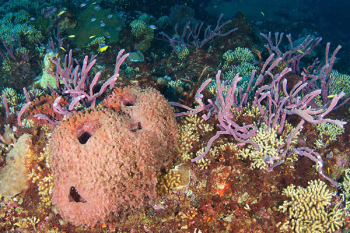
The deep sea is cold, dark, with extreme pressures and limited nutrients, yet it is full of diverse life. Out of sight, and often out of mind, the mesopelagic zone, or ocean twilight zone, is the realm between the surface and ocean bottom. It occupies a huge portion of the ocean.
Lots More Jellies in the Deep Sea
With new tools for exploration, scientists are discovering a wide diversity of animals in this seemingly inhospitable realm. They are finding far more jellies in the oceans than previously believed, in both more diversity, and numbers. This diversity includes Cnidarian “jelly” medusae, both large and small. Researchers have found that they live at various depths and that the number of species increases with depth.
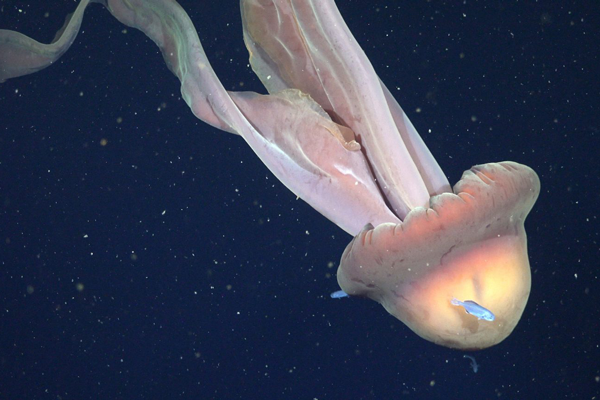
For example, scientists discovered a giant phantom jelly(Stygiomedusa gigantea, in photo above) that lives as deep as 22,000 feet. Watch a video here.
Adaptations
Light diminishes with depth and animals living in the twilight zone have various adaptations to the dark. Many are bioluminescent – they make their own light— with chemical reactions. Bioluminescence is common in the deep sea: researchers at MBARI found that three-quarters of the animals make their own light. And bioluminescent jellies are common in the deep.
Bioluminescence provides a way for deep sea animals to communicate, avoid predation and attract prey in the darkest part of the ocean.
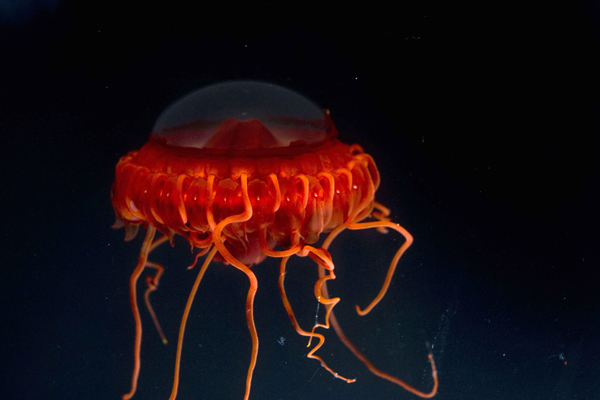
In the midwater, many jellies are transparent but have red stomachs to hide their prey. At greater depths, some jellies, like Atolla above, are red. They contain porphyrins, a reddish-brown pigment found in many deep sea medusae. It’s a compound that’s only stable at depths. They become toxic compounds when exposed to bright lights, so they have to be in the deep dark. Scientists aren’t sure about their use, but despite appearing red when illuminated (like from a research submersible), they have absorbance of bioluminescent wavelengths. In the deep the red actually appears black and so these medusae are less visible to predators and prey.
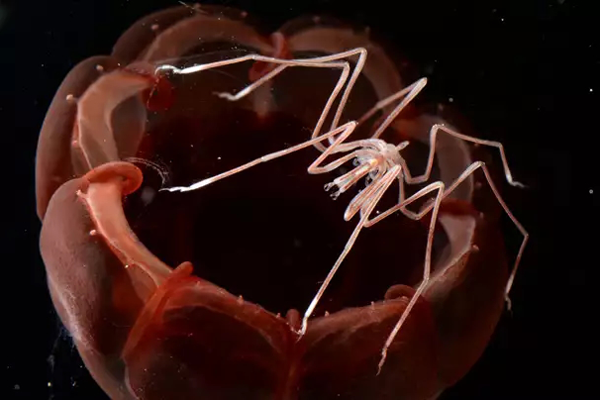
Since there are no surfaces in the open waters, an often-seen adaptation in the deep sea is the association of different kinds of animals. Amphipods and sea spiders might live inside hydromedusae. The giant deep sea phantom jellyfish provides shelter for fish, as observed by MBARI scientists in a realm where there are few places to hide.
Adaptation to high pressure
In the deep sea, atmospheric pressure is extremely high. Researchers wonder how deep-sea creatures can survive those crushing pressures. The phantom jelly can live to depths of 22,000 feet, which is 10,000 pounds of pressure. Deep-sea medusae are mainly made of water. Unlike vertebrates, medusae lack rigid skeletons so their gelatinous bodies can bend and compress easily, think jello. They also don’t have any air spaces that could compress their bodies in the extreme pressure.
Adaptation to Cold
Jellies generally are not highly active animals that use a lot of energy. This allows them to survive in the extremely cold water in the deep that slows their metabolism.