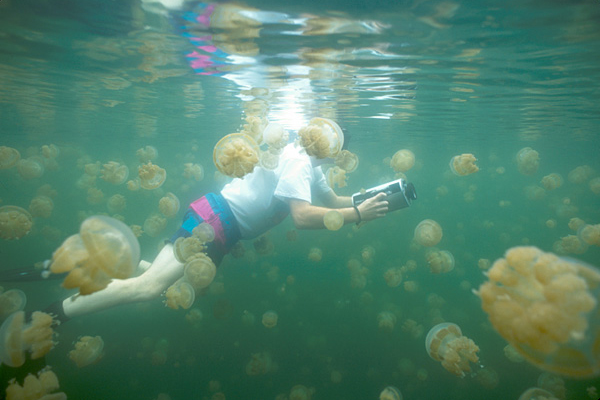
Sometimes jellies in an area will reproduce rapidly, forming what is known as jelly blooms. Jellies are short lived and so when there’s a mass die-off of these blooms, their carcasses sink through the ocean to the bottom. These are called jelly falls. The body of an individual jelly is mostly water, but when there are blooms of thousands, there is a significant amount of carbon present.
Scientists call the transport of carbon from the surface to the deep the biological pump. This is part of the global carbon cycle that moves carbon out of the atmosphere and into the depths that happens all the time everywhere in the ocean. Since jellies have fast sinking rates, they are a “globally significant source of organic carbon for deep-ocean ecosystems, with 43-48% of their upper ocean production reaching 2000 meters.”
When there’s a jelly bloom and then a jelly fall, a pulse of carbon reaches the seafloor. Scientists are trying to understand what these events mean for carbon transport. With climate change warming the ocean and changing ocean chemistry, jelly blooms have become more common in some places. What might this mean for the biological pump? Researchers are looking for answers.