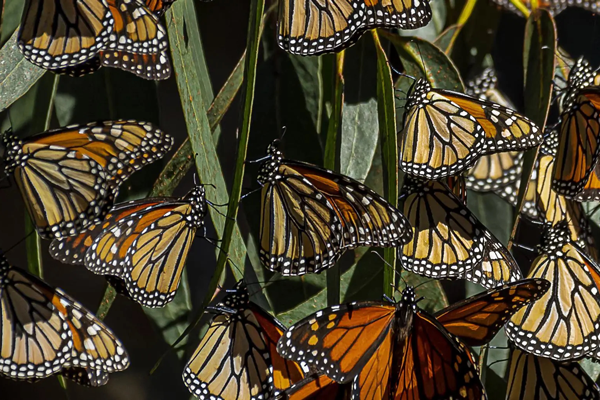
Monarch butterflies are adored by many and easily recognized by their stunning orange and black wing pattern. Many classrooms raise monarch caterpillars to watch the unfolding of the lifecycle from caterpillar to chrysalis to the emergence of an adult monarch.
These lightweight creatures (weighing less than half a gram) fly long distances over several generations, an unbelievable migratory phenomenon.
Built for the Long Haul
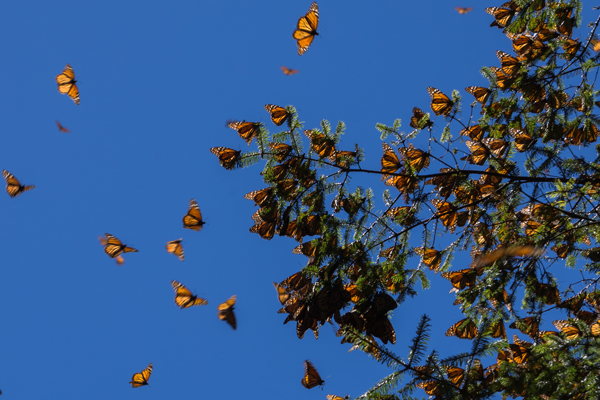
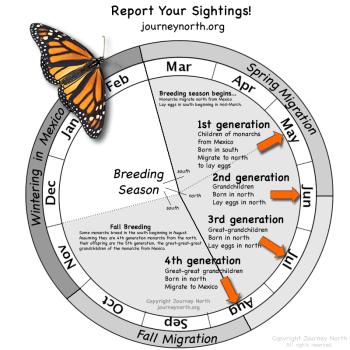
Adults born in the summer live from two to five weeks, producing the successive generations. Monarchs can’t survive the winter cold, so each year the final ‘super’ generation emerges in late summer and early fall and migrates up to 3000 miles to their overwintering grounds, either in central Mexico for eastern monarchs or in coastal California.
The east coast population migrates from the northeast United States and southeast Canada to the mountain forests of the Monarch Butterfly Biosphere Reserve in central Mexico, where they overwinter from the beginning of November to mid-March. Here they survive the long winter living up to eight or nine months.
Western monarchs make their annual migration to overwinter in groves of trees (mainly eucalyptus) along the coast of California where they cluster tightly in the trees to stay warm. Each spring, the butterflies fly across the west to lay their eggs on milkweed and drink nectar from flowers in Arizona, California, Nevada, Oregon, Washington, Idaho, and Utah. For both populations, the return trip to their spring homes can take several generations of monarchs to complete.
A Strong Sense of Direction
How do the butterflies navigate to their overwintering grounds? They have two sophisticated navigational systems. Like many flying animals, they rely on a system that orients them to the sun, keeping them pointed south. When the sun isn’t visible, monarchs use their compass sense that relies on ultraviolet light to detect the angle of the Earth’s magnetic field.
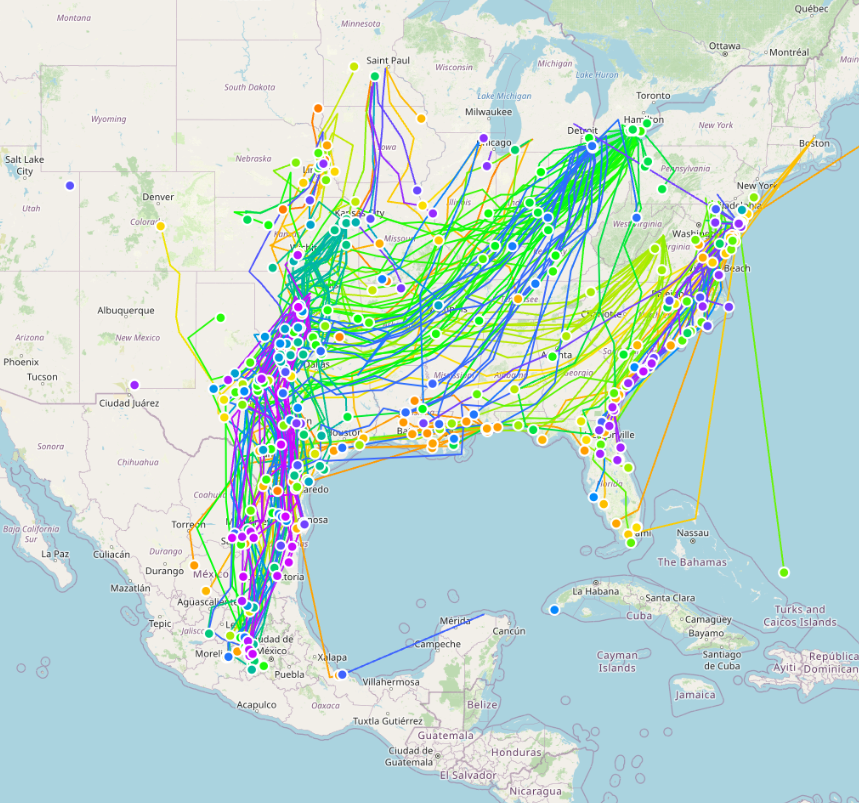
Scientists have long had questions about the monarch migration. They wondered about the routes these delicate butterflies take to the long-distance places, and what dangers they face along the way. Researchers can now track individual butterflies with new, tiny, solar-powered sensors, “…each tag-bearing migrator making the transcontinental journey is, by weight, equivalent to a half-raisin carrying three uncooked grains of rice.”
The older tags are stuck onto individual butterflies and rely on people finding butterflies in Mexico or California. Monarch Watch oversees the annual sticker-tagging of more than 100,000 monarchs, but fewer than one-percent are recovered. Those that are recovered only tell where the insect started.
New Ultralight Tags
The new ultralight tags allow scientists to see the details of a butterfly’s journey as shown in maps above. These sensors are different: they use Bluetooth to allow tracking in real time along their entire migration journey. One monarch travelled more than 100 miles in two days! That’s quite feat for a tiny, delicate animal. Tags reveal how some butterflies are blown off-course (not surprising) but manage to find their way to the overwintering grounds. Other monarchs have been tracked to smaller, new colonies.
The value of these new tags is to inform conservation research and efforts. Monarchs need nectar from specific flowers to fuel their flight, milkweed for the caterpillars, and safe places to rest when storms or winds blow them off course. How do we protect declining monarchs from the impacts of climate change loss of host plants and winter habitat? Knowing the routes that the butterflies take and how they may shift their routes and destinations will help protect both populations.
This is a lesson plan from our friends at Science Friday on tracking monarchs.
If you want to track monarchs you can download the Project Monarch App, where you can log any sightings, and the Bluetooth technology in your phone will also help triangulate other butterflies that might be in the area.